Lexing lab questions?
Parsing 2.3
Parsing or syntax analysis is the process of analyzing a string of symbols conforming to the rules of a formal grammar.
Calculator Example
Supported operations
1 + 24 - 22 * 38 / 4
Goal
- Scan a string such as “1 + 2 * 3” and determine if it is a valid operation, and order it so it can be executed.
Chomsky Hierarchy
Grammar Automaton (Computer)
Unrestricted Turing Machines Context Free Pushdown Automata Regular Finite State Automata
Context-free Languages
Big Idea
- Grammar rules are applied recursively to generate members of the language.
- Grammar rules can be applied in reverse to parse a string to determine language membership.
- The parsing process can result in a parse tree showing token structure.
English Example
- S -> NP VP
- NP -> Adj Noun
- NP -> Noun
- VP -> Verb Adv
- VP -> Verb
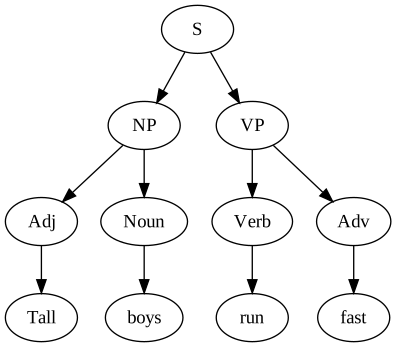
Implementing a parser

Top-down parsing
- Begins with overall structure (sometimes guessed or assumed) and then determines details
- Top-down refers to order in which nodes in the final parse tree are determined

Bottom-up parsing
- Determines low-level details first then builds our surrounding structure.

Shift-reduce parsing
- Bottom-up
- Shifts tokens onto a stack
- Reduces them when they match against a rule
LR Parsing
- Shift-reduce, bottom-up parse
- Left-to-right, Rightmost derivation first
- Deterministic algorithm
- Linear time performance
Calculator Grammar
- expr -> number
- expr -> expr operator expr
Shift-Reduce Trace
Parsing “1 + 2”
Shift:  1
Reduce: (expr 1)
Shift:  +
Shift:  2
Reduce: (expr 2)
Reduce: (expr (expr 1) + (expr 2))
Result: (expr (expr 1) + (expr 2))