4.4 Synchronization Patterns
Producer-consumer model
- One thread produces data consumed by another thread
- Can be implemented sequentially
- Can be implemented as threads that wait on one another, but with limited concurrency
Concurrency
- Producer and consumer run at the same time
- Producer creates output and stores it
- Consumer grabs input as needed from storage
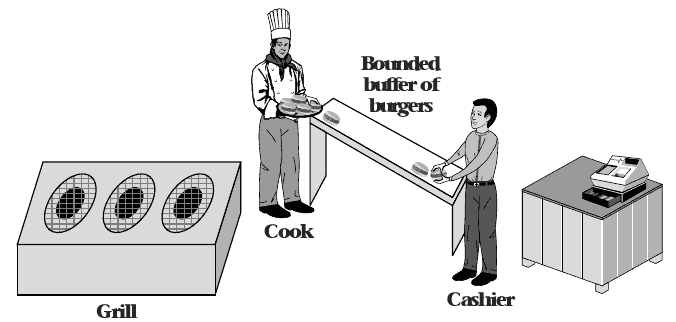
Bounded Buffer
- Provides storage space for producer output
- Limited in space because space is finite and larger size produces diminishing returns
- When buffer is empty, consumer must wait
- When buffer is full, producer must wait
Spin-waiting Producer
Spin-waiting Consumer
Pipes
- Provide OS-level support for bounded buffers between processes
du | sort -n
Readers/Writers Locks
- Alternative to mutex
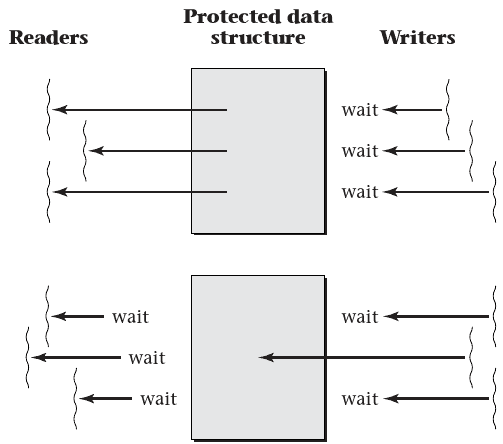
- Allows lock to specify whether thread is reading or writing
- Only one writer may access the mutex at a time, but multiple readers are allowed
Barriers
- Requires multiple concurrent threads to finish a task before moving on
- Similar to our use
pthread_join, but does not require threads to terminate
Condition Variables
- Provide a way to bundle multiple threads waiting on the same condition
- A signaling mechanism is used to wake threads when the condition is met
Condition Variable Producer
Condition Variable Consumer
Semaphores
- Somewhat similar to a mutex, but can take on values other than 0 and 1
- A semaphore that uses only 0 and 1 is a mutex
- Larger counter values can be useful when implementing bounded buffers or other concurrency mechanisms
4.7 Deadlocks
Concurrency
- Addresses problems of responsiveness and throughput
- Creates problems with data races
- Races can be resolved using synchronization patterns
What problems can be caused by synchronization?
Example
Analysis
- Mutexes prevent race conditions
- Transfers will generally work correctly
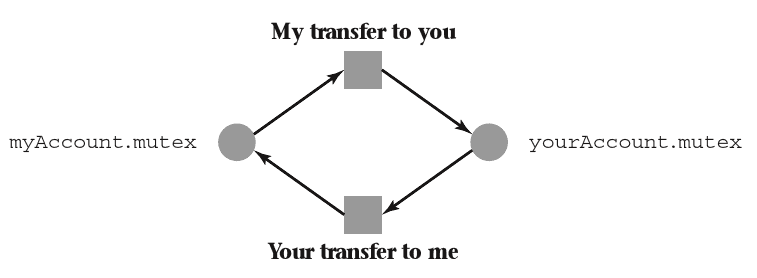
- What if two accounts transfer to one another concurrently?
Deadlock
- Each thread locks the first mutex and waits for the second
- They now have a circular dependency and will never progress or unlock their mutex
Deadlock conditions
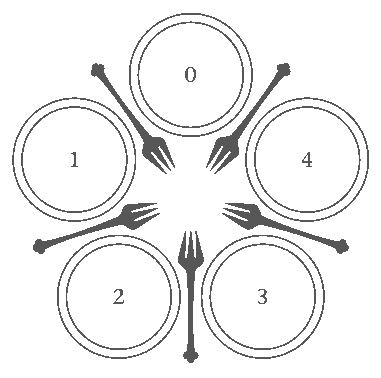
- Threads hold resources exclusively
- Threads hold some resources while waiting for others
- Resources cannot be removed from threads by force
- Threads wait in a circular chain
Addressing Deadlocks
- Detection and mitigation
- Prevention
Detection
- OS stores additional information about mutexes
- Track which thread holds a mutex
- Record which mutex a thread is waiting for
- Use this graph to periodically check for cycles (deadlocks)
Breaking the Deadlock
- A thread can be rolled back to before it attempted the offending lock
- Most systems don’t support rolling back threads
- Killing a thread is the typical solution
Immediate detection
- If we detect deadlock conditions when the last lock in the cycle is attempted, we can notify applications and they can choose to take appropriate action
Prevention Through Resource Ordering
- Requires resources to have global IDs
- When locking resources, lock them in order by ID