Strings
Definition
- A string is a sequence of characters
- String literals can be created using single or double quotes
Valid Strings
Accessing Items
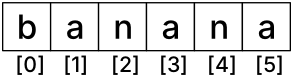
- A string is a sequence
- Items in the sequence can be accessed using square brackets
[]
Example
Immutability
- Strings in Python are immutable
- This means they cannot be changed
Example
Creating a New String
- If we need to change a string we must create a new modified version
- This can be accomplished using string expressions
Looping
- Strings are iterable
- We can easily loop over the characters in a string using
for
Example
in
- The
inoperator can be used with strings - An
inexpression will return true if the value on the left is contained within the value on the right
Example
String comparison
- Comparison operators are defined for strings
==checks for equality as expected<and>are a little more complicated
Example
Alphabetical order
- Generally, comparison operators can be used to confirm whether strings are in alphabetical order
- All uppercase letters come before all lowercase letter
Example
Create a program to print every other letter in a string
Create a program to find a word in a string and print the position of the word