Lab Notes
Assignment
- Used to store values for later use
Converting to Integers
intcan be used to convert values into integers
type
typecan be used check the type of a value
Storing converted values
intdoes not modify value in place- Results must be stored or used
Getting Help
- Reach out if you need help on a lab
- Other students can be a great source of help
- Learn to know when you are using other resources as a crutch
Conditional Execution
Control Flow
- By default, the Python interpreter runs the next instruction in our program
- In order to create more complex programs, it is helpful to choose which instruction runs next
- This is modification of the control plane of program execution
if statement
- Conditionally runs a block of code
- A Boolean expression (the condition) follows the if statement
- The
ifstatement is terminated by a:
Example
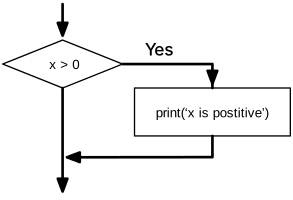
if control flow
diagramCompound Statements
- Statements may be grouped together into blocks
- Blocks of statements should be indented using 4 spaces
Example
New Operations
Integer division
//performs integer division%is the modulo operator and computes the remainder after division
Division Example
Modulo Example
Why would we want a modulo operation?