Instructing Computers
Telling a Computer What to Do
- Natural Langugage
- Applications
- Programming
Natural Language
- Comfortable for humans
- Lacks specificity
- Lacks precision
- Difficult for computers to interpret perfectly
Ambiguous Language
The professor said on Monday he would give an exam.
Ambiguous Language
One morning, I shot an elephant in my pajamas. How he got in my pajamas I don’t know.
—Groucho Marx
Large Language Models
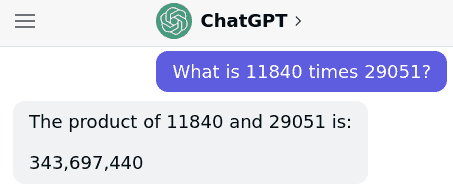
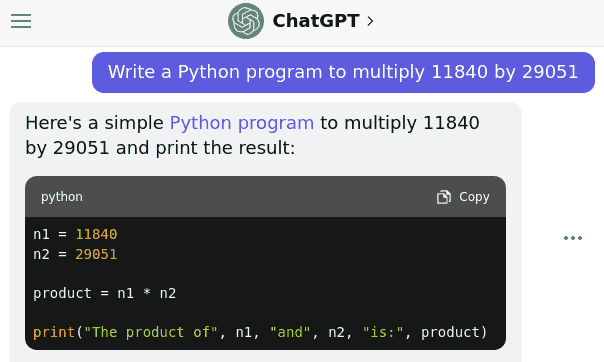
- Completions are inherently stochastic
- Results may not be exactly correct or what a user intends
- Need precise inputs to match precise requirements
Large Language Models
- Incredibly powerful tools
- Growing more powerful rapidly
- Still require expert knowledge for many use cases
Apps
- Another approach to instructing computers
- Work well for pre-defined tasks
- Must be created by someone
Programming
- Provides direct instruction to the computer
- Can be used to compute anything computable
- This can do nearly anything
Programming
- Not just for experts
- Can be a satisfying, creative experience
- Opens up new means for intellectual expression
- Is basically a superpower
Programming Challenges
- Learning a new language
- Understanding what computers can do efficiently
- Solving problems algorithmically
Problem Solving
- Required to program computers
- Analysis at appropriate level of abstraction
Computational Thinking
Formulating problems such that solutions can be represented as computational steps
Process
- Problem Formulation - Conceptualize a problem
- Solution Expression - Formulate unambiguous algorithm
- Execution - Computer runs instructions to produce result
- Evaluation - User explores result to confirm thinking
Algorithm
- Step-by-step process to solve a problem
Example Problems
Simple Computer
- Tape-based computer with programmable head
- The number under the head can be
scanned - One number can be
storedin the head - A
counterin the head can be incremented


Instructions
- Move head left
- Move head right
- Stop if
scannedis empty - Stop if
scannedmatchesstored - Increment
counter - Increment
counterifstoredmatchesscanned - Repeat
Count the number of items on the tape
counter should be equal to the count of the items on the
tape when the machine stops
Counting
- Stop if
scannedis empty - Increment
counter - Repeat
Search through list for an item matching stored
The machine head should stop with the head on the first match if there is a match or stop after the end of the list if there is no match.
Search
- Stop if
scannedmatchesstored - Stop if
scannedis empty - Move head right
- Repeat
Count the number of matching items in a list
counter should be equal to the count of matching items
on the tape when the machine stops
Counting Matches
- Increment
counterifscannedmatchesstored - Move head right
- Stop if
scannedis empty - Repeat